
★★★½ (3½ out of 4)
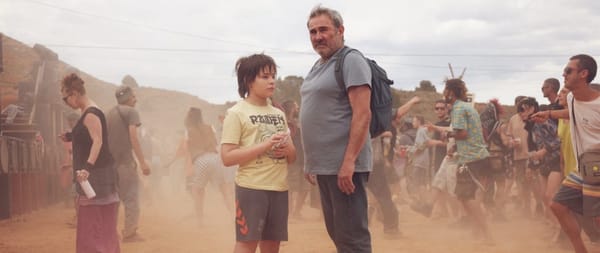
Propelled by the thumping bass of its score, “Sirāt” is Spain’s submission for the Oscar as Best International Film. On the surface, the French-born Spanish director and co-writer Oliver Laxe seems to be telling the deceptively simple story of Luis (the great Sergi López), a bulky, middle-aged father trying to find his missing daughter, Mar. He’s not alone. Luis is with his young son, Esteban (Bruno Núñez Arjona), and the family dog.
Right away you must consider the location: a mountainous stretch of southern Morocco in the Sahara Desert. And the characters: nomadic European ravers who have come in trucks and camper vans. And the reason they are there: to attend the rave of raves and be swept away on a wave of nonstop music spewing from huge speakers unanchored in the sand. Hardly an appropriate spot for a desperate father with a boy and a dog to do police work.
Nothing about the pulsating ‘Sirāt’ is appropriate or expected or traditional or fully comprehensible. It just is. And it is utterly transfixing.
Here’s where I should note that nothing about the pulsating “Sirāt” is appropriate or expected or traditional or fully comprehensible. It just is. And it is utterly transfixing. Start with the music, composed to a feverish beat by electronic virtuoso Kangding Ray, which effectively envelops everything in its sonic path, as does Laia Casanova’s sound design that adds the music and menace of nature. Even the ecstatic sounds that drove the Shakers of “The Testament of Ann Lee” into frenzied, semi-religious delirium couldn’t stand against this blast as we watch Tonin (Tonin Janvier), with a prosthetic leg, and Bigui (Richard Bellamy) missing most of one arm, gyrate madly toward their own idea of salvation.
“Sirāt” follows no rules, but it does keep Luis and Esteban in its sights as they learn from the ravers, including Stef (Stefania Gadda), that the missing Lar may be headed to the same spot they are, a rave farther south near Mauritania. No one knows anything for sure and the cliffs in the distance are sentinels of silence. But since the Arabic word sirāt refers to a shaky bridge over hell that can lead to a possible paradise, everyone is ready to set off.
Are there complications? You bet. Soldiers order the ravers to depart in the light of armed conflict ahead. That may presage the end of the world. But five persist as Tonin and Bigui are joined by Jade (Jade Oukid), Stef (Stefanía Gadda) and Josh (Joshua Liam Henderson) for a journey into the unknown. For Luis and Esteban, there is no other choice but to follow.
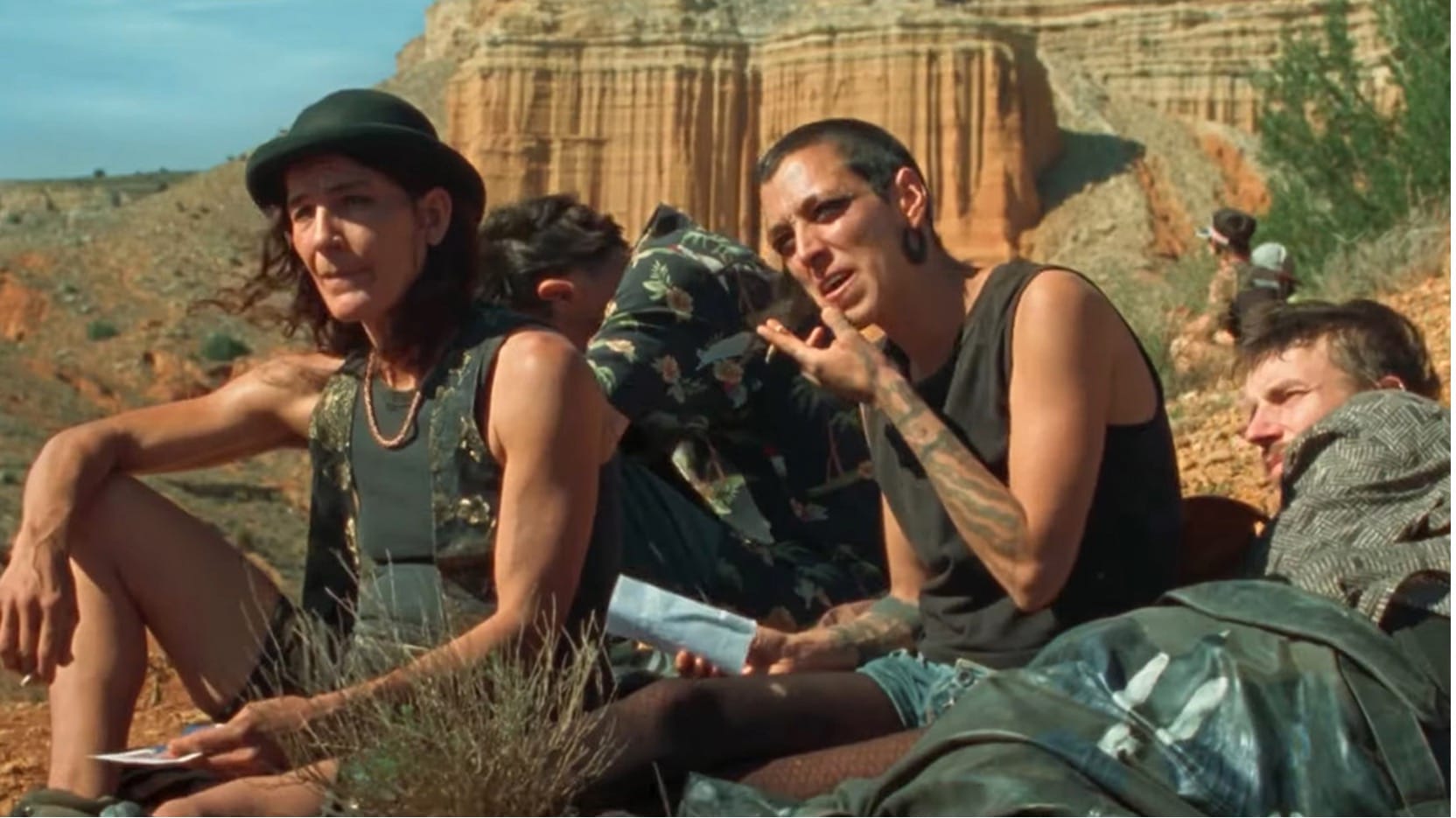
What happens next is best left for you to discover on your own as “Sirāt” drifts into an ending that is necessarily more quiet but no less meaningful for the characters involved. Director Laxe continues his habit of working with nonprofessional actors, whose lived-in authenticity more than compensates for their lack of experience. Lopez is the exception, of course, the consummate actor of “Dirty Pretty Things” and “Pan’s Labyrinth” who brings ferocity and genuine feeling to the film’s most turbulent role.
Shot with a poet’s eye by cinematographer Mauro Herce, “Sirāt” revels in what brings humans together despite the lack of common language and customs. Music is one of those things since the ravishment of sound is universal. But so is the kindness of companionship in the face of despair that reflects a seemingly unending refugee crisis.
“Sirāt” can deliver action on par with “Max Max: Fury Road” and still stop to notice something as gentle as a caring touch. The film’s characters are crossing minefields, literal and figurative, and no one comes out without a scratch. These itinerant ravers, techno dancing in the face of extinction, are showing us a world on a precipice. And it’s a world that looks scarily like our own.