
★★★★ (4 out of 4)
Go ahead, start nitpicking. I don’t care. “La Bola Negra” swept me away on ravishing waves of beauty, terror and sexual revolution. Spain’s Oscar entry for Best International Film opens in U.S. theaters Oct. 16 before hitting Netflix on Dec. 2. But why stop at international film? Can this gay epic take down “The Odyssey” for Best Picture? Don’t count it out. In 2017, “Moonlight” broke the queer barrier that “Brokeback Mountain” couldn’t. Two years later, South Korea’s “Parasite” did it for subtitles. We’re on a roll here. OK, Netflix has yet to crack Oscar’s top prize, streaming being the sworn enemy of theatrical presentation. Could “La Bola Negra” be the way in? Why not? I loved it with a passion.
Directed by Javier Calvo and Javier Ambrossi, collectively known as Los Javis (they wrote the screenplay with Alberto Conejero), “La Bola Negra” tells three stories over three different time periods: 1932 Granada, the 1937 Spanish Civil War and 2017 Madrid. Be patient while you wait for connections. They have a tendency to sneak up and floor you.
In 1932, wealthy young Carlos (the handsome, haunted Milos Quifes) is refused membership at an exclusive gambling club in Granada. The members use a white ball for yes and for no a black ball (la bola negra), an early example of the term blackballing. Black balls dominate the vote against Carlos due to rumors of his homosexuality. His father tells Carlos to apply again and to deny who he really is, a not so subtle metaphor for life in his homeland, where you go along to get along, erasing things that alter progress.
A monumental achievement that gets inside your head and heart and makes you see the world with new eyes.
Singer-songwriter Guitarricadelafuente, in an outstanding debut performance that should have Oscar calling, carries us into the Spanish Civil War. He’s Sebastián, a trumpet player whose life is about to change when his small village is bombed in a battle between the Republicans, liberals defending Spain’s elected republic, and the Nationalists, Nazi-aided, Fascist conservatives led by General Francisco Franco, whose dictatorship lasted until his death in 1975.
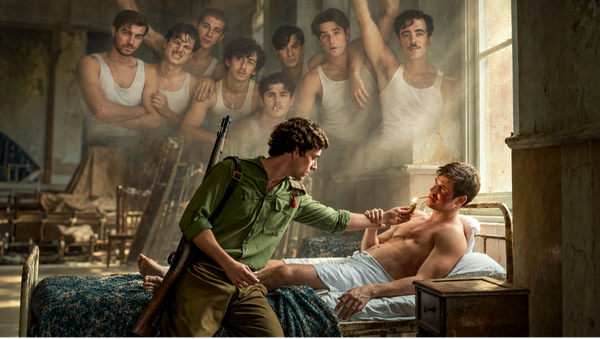
In his confusion, Sebastián becomes our guide into the chaos of war. Forced to join the Nationalist side, he is given a rifle and conscripted into the army. His first job is to guard a wounded Republican POW Rafael Rodriguez Rapún (Miguel Bernardeau, sensational in his rapt stillness), who belongs to a theater company run by the celebrated poet/playwright Federico García Lorca (“The House of Bernada Alba”), his lover.
The naïve, inexperienced Sebastián finds himself attracted to Rafael, who teaches him about Lorca’s poetry and a desire he can’t name. The growing bond between the uniform and the prisoner is the core of “La Bola Negra,” as it movingly expresses feelings not easily articulated. Los Javis conceived this relationship as the kind of queer love story that history erased, though millions lived it. Dialogue has been stripped away, leaving the eyes of the actors to carry what they cannot say. And to watch Bernardeau and Guitarricadelafuente find each other in the space between words is tremendously moving, be it a shared cigarette or stolen kiss.
Artificial digital trickery is rigorously avoided. Even the film’s large-scale features, such as a fallen statue of Saint Sebastian, a gay icon, that Sebastián climbs, were physically constructed to maintain the film’s grounded aesthetic focused on “guerra sin épica” (war without epic) which prioritized harsh daily survival over polished, grandiose spectacle. The intent here is to allow silenced gay histories to climb into the light as Sebastián climbs out the ruins of a bombed church literally using the arrows protruding from the saint’s stone flesh as a handholds.
Likewise the appearance of Penelope Cruz in an electrifying extended cameo as Nené Romero, a cabaret singer who uses her music and flamboyant theatricality as a vital emotional release in a world dominated by fascism, violence, and the suppression of queer and individual identities. Cruz makes every moment count.
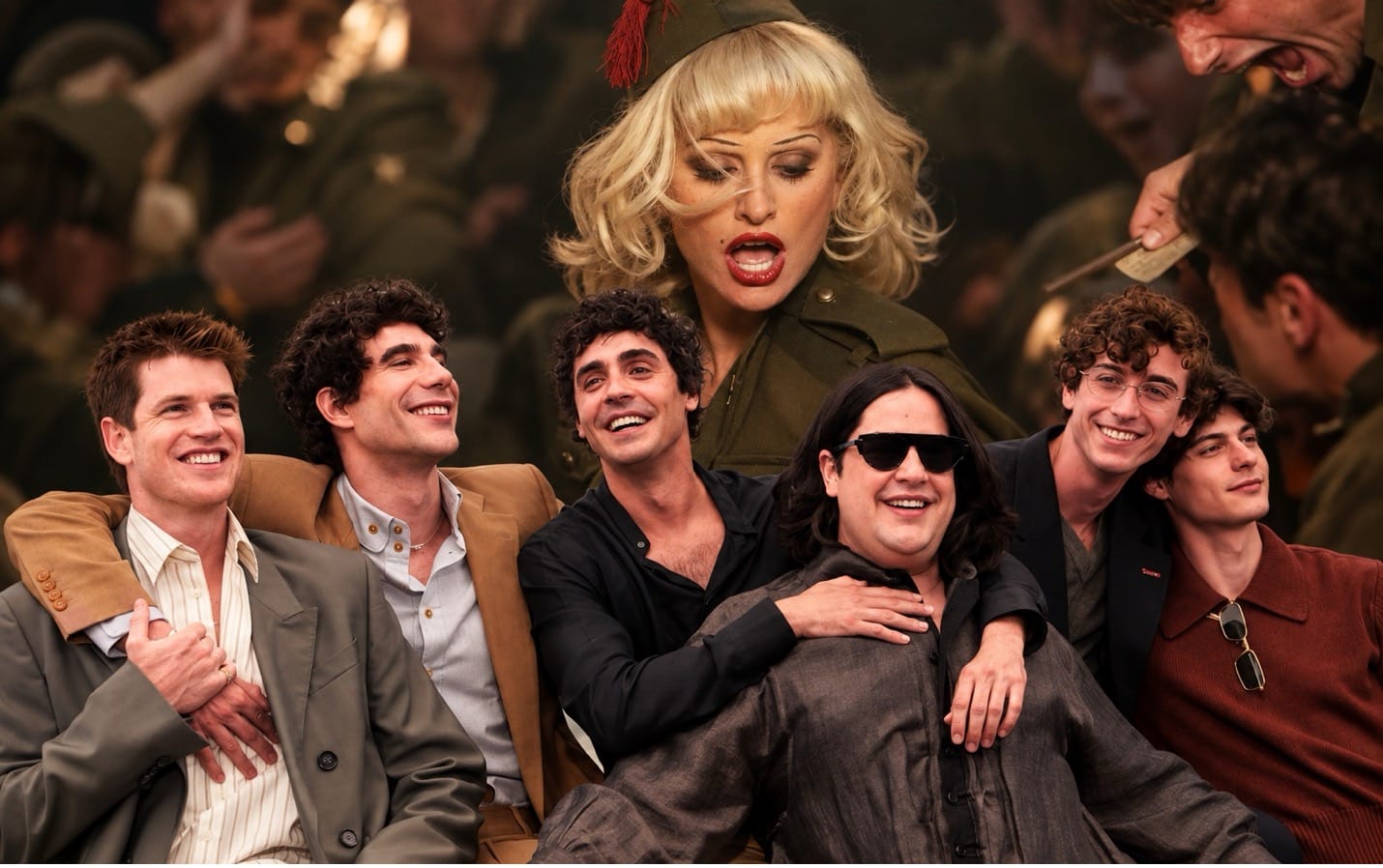
Los Javis, in tandem with cinematographer Gris Jordana (her lighting is breathtaking), editor Alberto Gutierrez, who makes cutting an art form, and genius composer Raul Refree, create miracles of image and sound. Scenes of raw carnage link with moments of human connection as intimate as a whisper. In a time when same sex attraction was criminal, Los Javis flood the screen with men in groups connected by carnality, yes, but mostly a comradeship no longer hidden but a defiant affront to repression that plays like an exhilarating gift.
The 21st-century scenes show a changed Spain still ruled by outmoded views of sin. In 2017, gay writer Alberto Azcuna (Carlos González) learns that his long-estranged grandfather—that’s Sebastián—has left him something in his will. His mother (the superb Lola Duenas) wants nothing to do with it. But the legacy, which involves a lost Lorca manuscript (no spoilers), fuse all three sections in a triptych that takes a piece out of you. Glenn Close is reliably luminous in the role of Spanish-speaking Isabelle Durand, a Lorca scholar who validates the authenticity of Alberto’s gift and the film’s core theme of "remembering as a way to avenge death" and unearthing Spain's buried LGBTQ+ history.
Is the film’s final leap into emotional catharsis a bridge too far? Perhaps. But those floodgates of emotion, gorgeously rendered by Los Javis, are righteously earned and deeply felt. The directors, previously known for TV work and the 2017 film “Holy Camp,” ended their 13-year relationship during the shooting of “La Bola Nergra.” Having shared the directing prize at Cannes and the prestigious Audience award at Toronto, Los Javis intend to continue creating professionally whether Oscar blows them kisses or not. Good plan. It’s impossible to pinpoint exactly how and when the monumental achievement of “La Bola Negra” gets inside your head and heart and makes you see the world with new eyes. But thanks to Los Javis it does—and then it owns you.