
★★★½ (3½ out of 4)
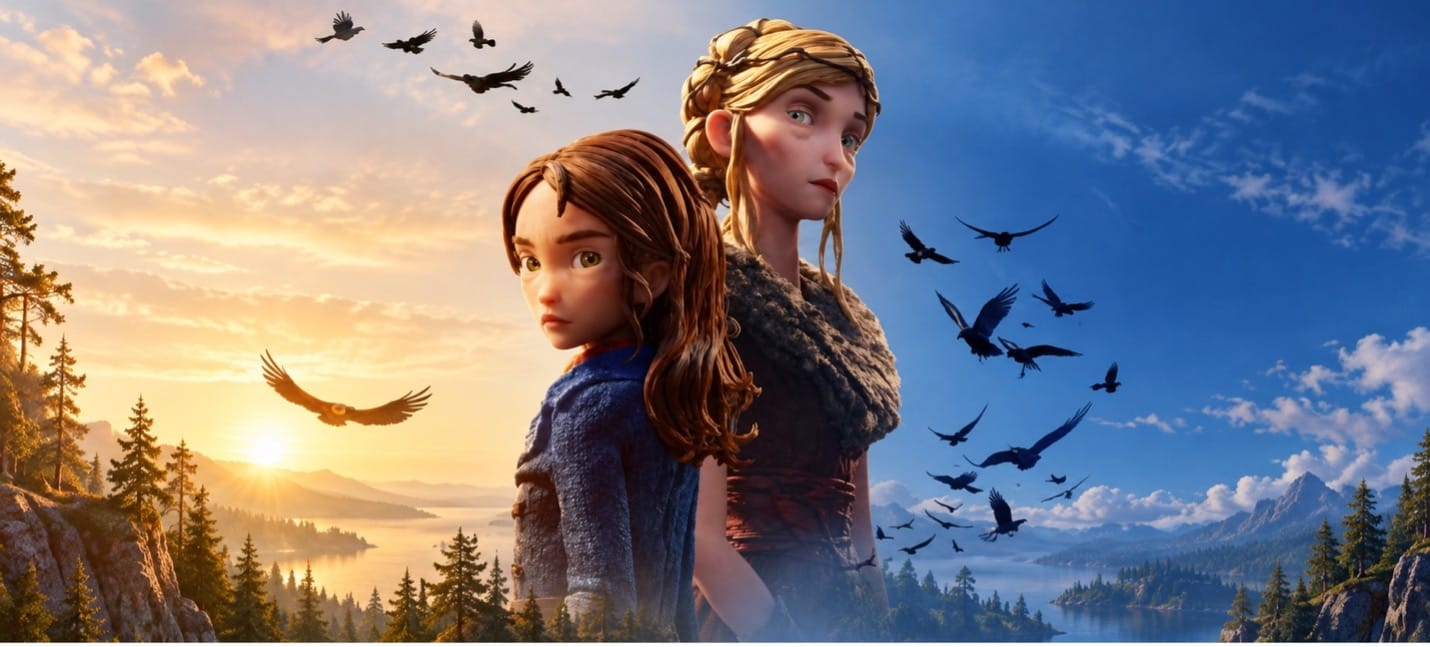
The search for the movie that must win the Oscar for Best Animated Film ends right here with the latest miracle from Laika studios. In the visual amazement called “Wildwood,” teenaged Prue McKee, voiced with fear-hiding swagger by Peyton Elizabeth Lee, is babysitting her baby brother, Mac (Arthur Knight), when a murder of crows swoops down and carries him off. For those not in the know about 15th-century hunting and folklore terms, a “murder of crows” is a traditional collective noun for a group of scavenger crows that collect near battlefields and other places associated with death.
It’s not a pretty picture. Parents should know the “Wildwood” is the first film from Laika rated PG-13. And with good reason. Yet Prue and her classmate Curtis (Jacob Tremblay) fearlessly follow the crows into the Impassable Wilderness, an enchanted forest just beyond Portland, Oregon, the home base of Laika itself.
What begins as a rescue mission pulls the pair into a struggle over the forest’s future, where powerful figures have their own plans—and grief and ambition make a dangerous combination. Getting Mac home means navigating a whole civilization hidden in the trees and director Travis Knight milks the situation for maximum excitement. That’s especially true when Carey Mulligan enters the scene voicing Alexandra, the Dowager Governess. She’s an exiled sorceress and the film’s chief villain, whose grief over her son’s death fuels her dangerous use of dark magic.
The Oscar for Best Animated Film belongs to this stop-motion miracle.
Intrigued? I bet you are. But the adventure story cooked up by Chris Butler from the bestselling novel of the same name by Colin Maloy and Carson Ellis, is not what makes “Wildwood” a fabulous film experience you don’t want to miss. It’s the animation, stupid, as the nastier crows might say.
Not just any animation—I’m talking about the stop-motion kind you might have seen in Laika’s “Coraline” or “Kubo and the Two Strings” and “ParaNorman.” Laika is celebrated for its dark, handcrafted fantasy stories and pioneering use of 3D printing in stop-motion animation. You need to know something about stop motion to fully appreciate why “Wildwood” is so bloody brilliant. It’s natural intelligence that guides us here, not the artificial kind. And thank the patient and fallibly human icons of animation for that.
Stop-motion animation is the art of making physical objects appear to move by photographing them one tiny adjustment at a time. An animator positions a puppet, takes a picture, moves it a fraction of an inch, and takes another. Played in sequence—typically at 24 frames per second—those still photographs become a continuous performance. A turn of the head, a fluttering wing, even a moment of hesitation must be created through carefully measured changes between exposures. Laika builds its films around real puppets photographed on physical sets.
The puppets are sophisticated little actors. Inside their bodies are articulated skeletons, called armatures, that let animators bend and position them while holding each pose steady. The exterior supplies the character’s skin, clothing, hair or fur. In “Wildwood,” designers used digital tools to plan these mechanisms before fabricating the puppets by hand. Every costume and moving part have to serve both the character’s appearance and the animator’s ability to manipulate it.
Facial expressions involve another painstaking process: replacement animation. Laika artists design expressions digitally and manufacture them with 3D printers. Animators then exchange the physical face pieces between photographs, making a mouth form words or a smile gradually disappear. The computer helps design the performance, but the printed expressions become tangible parts attached to a puppet and photographed under actual lights.
“Wildwood” pushes that craftsmanship into unusually elaborate territory. Its giant golden eagle, The General, voiced by Angela Basset who carries authority in her vocal chords, has a five-foot wingspan and 3,000 individual feathers. The filmmakers built different versions for different movements, including flying and folding its wings. Lightweight materials, an aluminum armature and motors in the shoulders helped make the enormous creature manageable. Even the forest required special techniques to give its vegetation a convincing sense of movement. Knight describes the practical and digital techniques as intertwined: each helps the other achieve effects that would be difficult alone.
What gives the technique its appeal is that sense of physical presence: light falls across an actual face, fabric has texture, and a creature occupies real space. The animator supplies the acting through timing, posture and the smallest gesture. It’s filmmaking by increments—a whole performance built from objects that never move while the camera is exposing a frame.
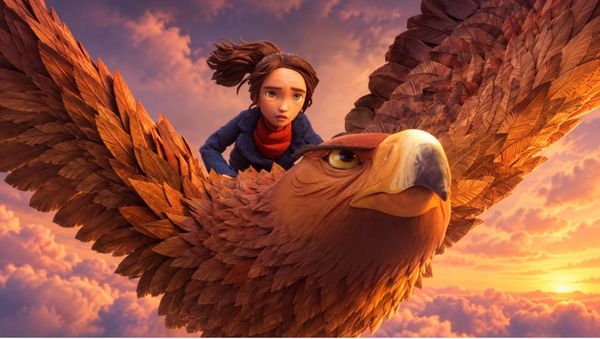
It’s not hype to say that “Wildwood” has been seven years in production,16 years in the making. This, of course, would mean little if “Wildwood” didn’t deliver when it comes to action and character. But it delivers like gangbusters. Everything feels intimate and epic as the birds gather, swoop down and carry Prue’s little brother away, to the breathtaking moment when Prue takes to the skies riding the General’s giant wings. Even the climactic battle when it seems the entire forest takes combat positions is an epic confrontation out of “The Lord of the Rings.” There’s little more to say except that “Wildwood” is spectacular in every sense of the word.