

★★★ (3 out of 4)
Writer-director John Carney doesn’t make musicals. The Dublin-born filmmaker and former bassist for the Irish rock band The Frames makes movies with music. Carney’s CV so far is impressive— “Once,” “Begin Again,” “Sing Street,” “Flora and Son”—all four movies making no distinction between song and story. Both exist in tandem to build characters of heart and mind who sometimes talk their feelings out better if they pick up an instrument and sing. Confession: I’m in the tank for Carney. He’s a Pied Piper who tells it true.
Case in point—“Power Ballad,” the fifth Carney film and the first to flirt seriously with darkness. Ultimately, Carney dodges his script’s deeper implications but what a kick to see him flying too close to the sun, where he risks getting burned.
Paul Rudd, an actor who defies age—at 57 he looks maybe 30— tackles the role of his career as Rick Power, a failed rocker settling for bridal gigs. He sings lead for The Bride & Groove— “Ireland’s grooviest wedding band.”
Rick moved to Dublin 15 years ago where he and Irish wife Rachel (Marcella Plunkett) and their 14-year-old daughter, Aja (a standout Beth Fallon) have settled in all comfy—a word that signals death to ambition. There’s an edge to Rick’s regret and that edge looks good on the usually unflappable Rudd.
Then comes the meeting that shifts things for Rick. At a posh wedding at a local castle, Rick encounters Danny Wilson, a former boy band idol who’s drifted at 27 into a stalled solo career. Danny is played quite well by Nick Jones of the Jonas brothers who knows the drill. When the groom, Danny’s friend, pushes him to get on stage with Rick, the two strangers click doing a duet cover to Stevie Wonder’s “I Wish.”
Later that night, Danny invites Rick back to his hotel for a jam session on keyboard and vocals. Whiskey loosens them up as they jaw about their frustrations. They share fragments of music and lyrics that they can’t seem to finish.
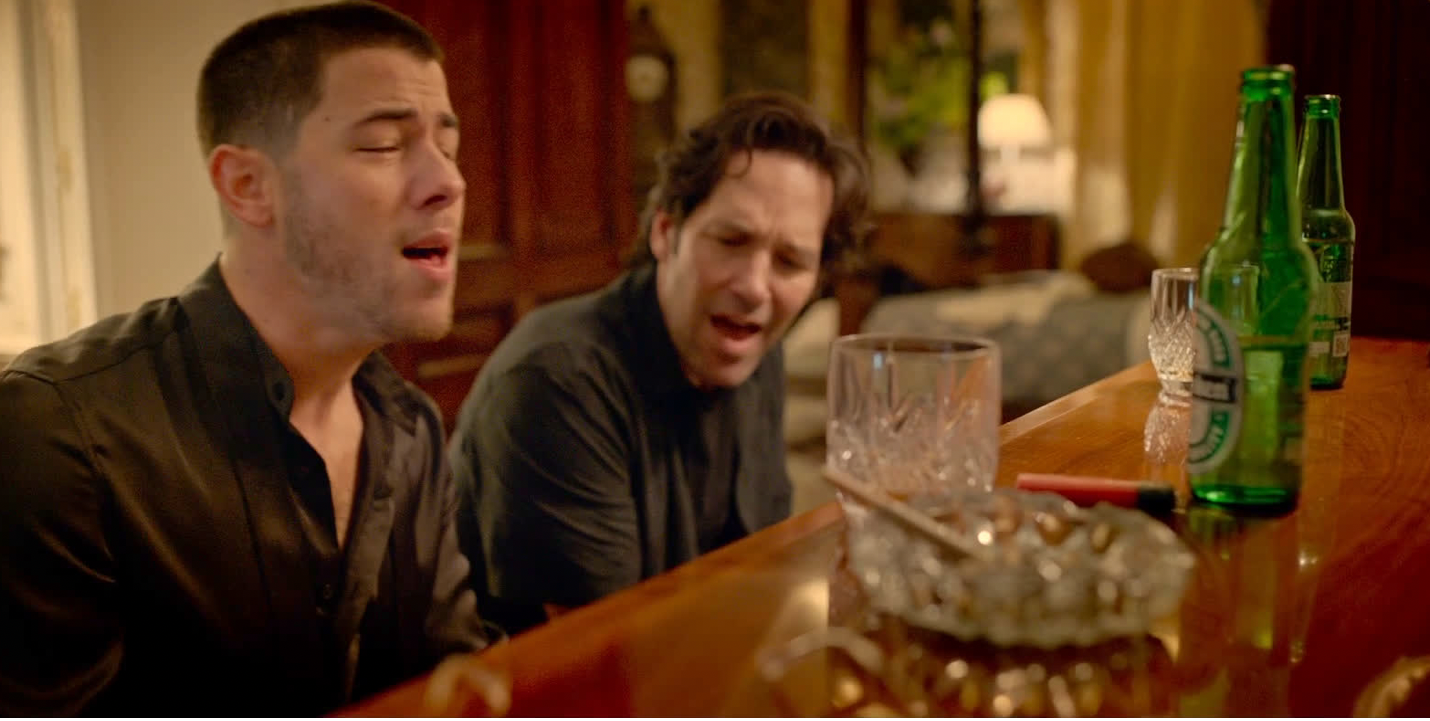
Their platonic all-nighter is a great showcase for Rudd and Jonas, who pair beautifully. We want more of this team, but Carny cruelly separates them most of the time. In a lesser movie, one not sharpened with hurt by Carney, the two would collaborate on a song that would instantly start charting and a solid creative friendship would be born.
Not here, which is all to the good. Oh, a hit single does emerge from that night. It’s called “How to Write a Song (Without You),” a soft-rock earworm that re-ignites Danny’s career. The trouble is Danny stole the bones of the song from Rick, without permission or apology.
When Rick hears it by accident at a shopping mall, Rudd lets painful feelings of betrayal and revenge wash over him like a gathering storm. And then they’re gone, as if Carney decided he didn’t want to go that dark.
We’re primed for battle when Rick and his best mate Sandy (a terrific Peter McDonald) head out to L.A. to confront Danny and his manager, Mac (sleazed to perfection by Jack Reynor). They want credit and compensation, but Mac keeps dodging their calls and so does Danny. How strange that Carney plays these scenes for cheap farce.
There’s a thornier, more emotionally raw movie hiding under the crowd-pleasing surface of this one. And that’s the movie I can’t get out of my head.
That laugh-clown-laugh decision doesn’t destroy the movie, but it sure dings it. Carney is savvy enough to know that unalloyed happy endings are as rare in the music business as they are in life. Harsh truths emerge in the gray areas. Danny was wrong to steal inspiration, but Carney makes it clear that Rick’s raw material would never have become a salable commodity without the changes in structure, style and performance added by Danny.
Carney himself put the words and the melody together for “How to Write a Song” with Gary Clark, and the result has the makings of a power ballad chart topper all on its own. Benson Boone, eat your heart out. It’s a tribute to the movie that Carney keeps taking the plot in unexpected directions. But there’s a thornier, more emotionally raw movie hiding under the crowd-pleasing surface of “Power Ballad.” And that’s the movie I can’t get out of my head.