
★★ (2 out of 4)
This sugarcoated and sanctified biopic sees the late Michael Jackson as a creative musical genius with a terminal case of arrested development. Look for more at your peril from “Michael,” an insight-free gloss on a life of byzantine complexity from which the Jackson estate has vacuumed out anything raw, relatable and scandal adjacent. The long-running Broadway musical, “MJ,” does the same. With Michael, big brother is always watching the bank.
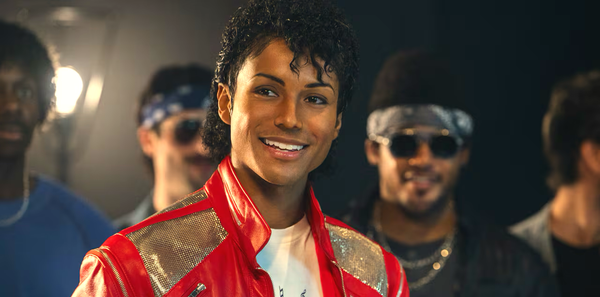
There are compensations in “Michael,” nearly all musical. Jaafar Jackson, Michael’s nephew, is such a dead ringer for his legendary uncle in looks, voice and gliding grace that you may think you’re seeing a ghost. He’s not some AI construct, but a living, breathing, generational talent who comes alive on stage. And onstage, Jaafar does his uncle proud. It’s when the music stops that director Antoine Fuqua (“Training Day”) and screenwriter John Logan (“Gladiator”), who should know better, cravenly regress to being keepers of the flame for a $200 million production.
A cash grab intermittently relieved by magic
Jaafar, 29 and the son of Michael’s brother Jermaine, was only 12 when his uncle died at 50 in 2009, having od’d on propofol, his reputation in tatters. Though never convicted of a crime, Michael settled two child sexual abuse cases. Reportedly, the last third of the film focused on one such case until the legal team discovered a clause in the agreement with accuser Jordan Chandler that specifically bars the mention or dramatization of him or his case in any film. I haven’t seen this unused footage, but my guess would be that it sided with Michael since this two-hour-and-seven-minute film, spanning 1966 to 1988, practically qualifies him for martyrdom.
For a villain, the movie settles on Michael’s late father, Joseph Jackson, played by the great Colman Domingo, bringing dimension to this ramrod steelworker in Gary, Indiana who didn’t spare the rod (he used his belt) when he decided to turn his kids into a meal ticket called the Jackson Five. Cheers to Juliano Valdi as young Michael, whose energy is infectious even when dad—the kids are ordered to call him Joseph—institutes his reign of terror. Mom Katherine (lovely Nia Long) offers sympathy but can’t stop that belt.
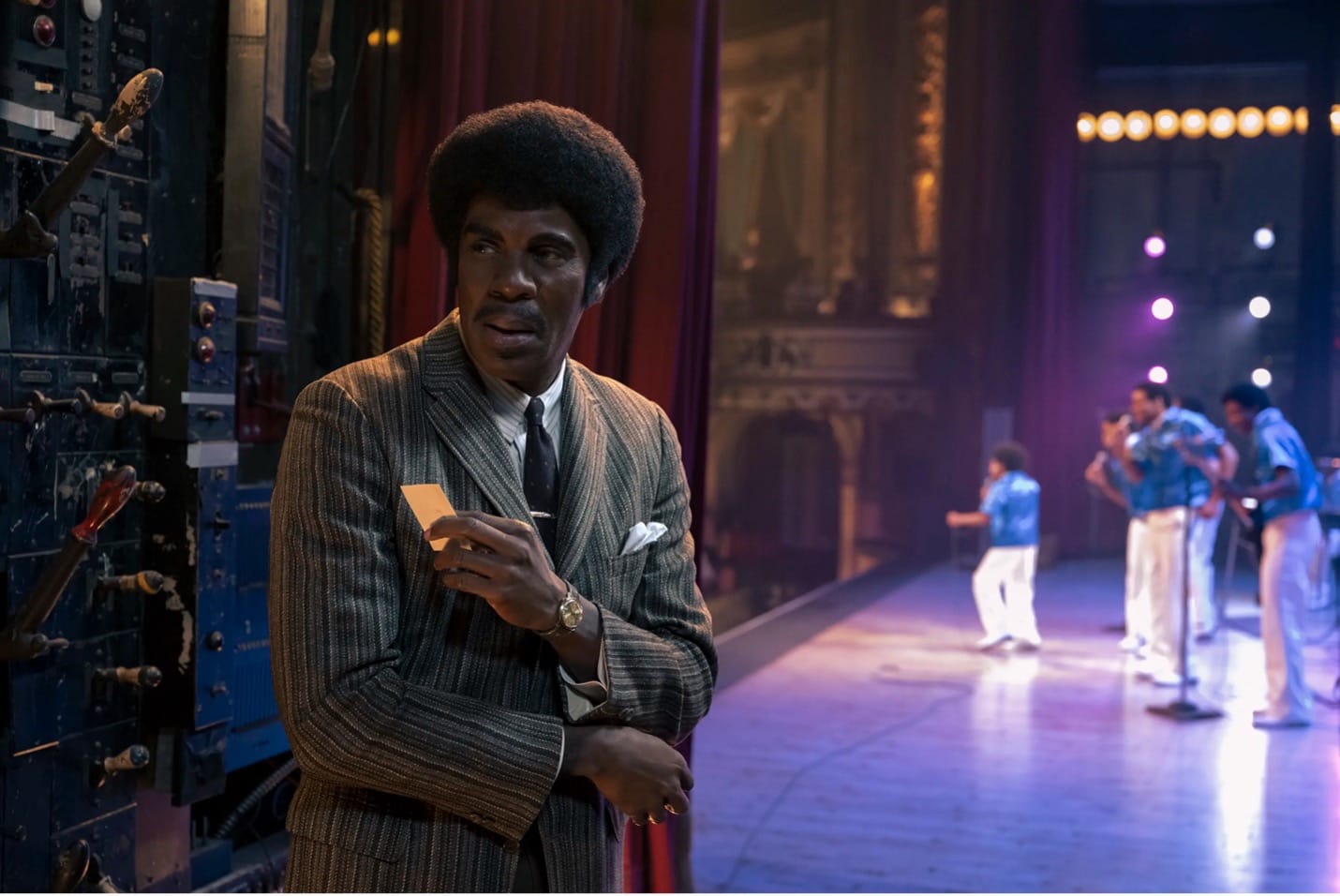
You won’t learn how Michael’s famous sister Janet Jackson felt since she (wisely?) declined to participate, as did his daughter Paris. Ouch! The pressure becomes palpable when Jaafar takes over the role and we feel Michael’s isolation, lost in stories about Neverland and Peter Pan, whose nose he tries to reproduce through surgery. Add his friendship with animals—enter Bubbles the chimp—and top it with a search for better fathers in Motown chief Berry Gordy (Larenz Tate) and bodyguard Bill Bray (KeiLyn Durrel Jones).
Michael shows some steel when he hires lawyer-manager John Branca (Miles Teller), who fires Joseph in a fax. Good one. Branca is sympathetically portrayed by Teller, though the manager is also an estate producer on this film. The inside associations make “Michael” a difficult movie to trust. Who’s in it for how much and why? These are hard questions to ignore, though Mike Myers nails it as CBS Records president Walter Yetnikoff, who pushed MTV in 1983 to make Michael the first Black performer to gain traction on that format.
It hurts the film when these rushed, generic machinations have all the heft of a Wikipedia page. Yet Jaafar—in his first film role—does his damnedest, finding nuances in the space between words, especially when Michael conceives and executes seminal videos for “Thriller” and “Bad,” using actual gang-bangers as choreographic inspirations, his hard discipline in striking contrast to the sweet, high voice that sells his songs to us and sometimes to himself.
Because of its cowardice to go past the official story, “Michael” lacks the soul necessary to stick to our minds and hearts. But when Michael does what Michael does, meaning holding us spellbound as a performer, Jaafar knocks it out of the park, his vocals blended with Michael’s—no seams showing—every move a kind of poetry. The music scenes, shot by Dion Beebe (“Chicago”), can go from sublime—Michael’s Motown 25 performance of “Billie Jean”—to irritating cutaways to cheering crowds that pledge we’re watching something extraordinary. We’re not. We’re watching a cash grab intermittently relieved by magic.
And yet “Michael” has the makings of a blockbuster, such is the timeless appeal of a performer the world won’t quit. “Michael” the movie keeps Michael at a safe and frustrating distance, his darkest days still to come as three words flash on screen: “His story continues.” Is that a threat or a promise?