
★★★½ (3½ out of 4)
Usually when I hear a film described as a “triumph of the human spirit,” I cringe at the prospect of sugar shock and grating self-congratulation. There’s a bit of that in “I Swear,” but not enough to slow the charge of genuine emotion pulsing through this true story of John Davidson, the Scottish activist honored with an MBE by Queen Elizabeth in 2019 for raising awareness of Tourette’s Syndrome. “Fuck the Queen,” said Davidson during the ceremony, unable to control the motor and vocal tics that come with the neurodevelopmental disorder, along with swearing, a tic known as coprolalia.
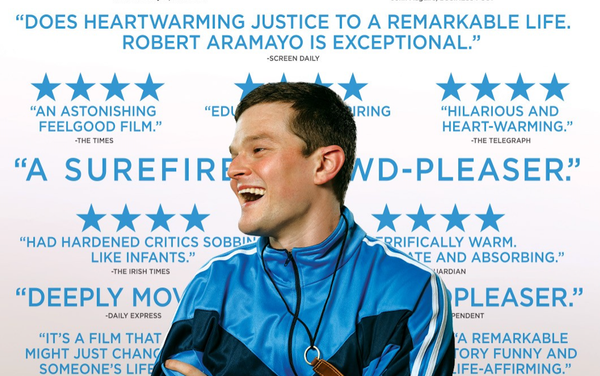
Last month, Robert Aramayo, the actor who plays John in “I Swear,” won a BAFTA award (the British Oscar), despite outsized competition from Leonardo Di Caprio (“One Battle After Another”), Timothée Chalamet (“Marty Surpreme”) and eventual Oscar winner Michael B. Jordan (“Sinners”). Controversy shadowed the award since Aramayo himself does not have Tourette’s, but must act out the symptoms, which he does astonishingly well, with both comic relish and serious compassion and respect.
Matters were made worse at the televised BAFTA ceremony in March when two Black “Sinners” actors, Jordan and Delroy Lindo, appeared on camera as presenters, prompting John to utter a racial slur that shocked the crowd since the BBC stupidly failed to delete the N-word from the tape-delayed broadcast. The ignorant thinking goes that ethnic slurs are in John’s vocabulary, so he must be a racist. All of us have heard these words just living in the world, speaking to the ignorance about Tourette’s that sadly persists.
It also speaks to the challenges Davidson, now 54, has faced since childhood. Written and directed by the British filmmaker Kirk Jones (“Waking Ned Devine,” “Nanny McPhee”), “I Swear” zips back to 1983 to the Scottish town in Galashiels, with a teen Davidson (a touching Scott Ellis Watson) coping with his first encounter with Tourette’s that turns his universe upside down. After a series of verbal eruptions, his father splits for good, his mother (Shirley Henderson) lashes out, he’s bullied at school, his football career goes up in smoke and he’s overcome with a depression that results in overmedication and isolation.

Aramayo, best known until now as young Eddard Stark in the sixth and seventh seasons of HBO’s series “Game of Thrones,” takes over the role as the older John learns to live in a world without empathy. His salvation starts when he meets Dottie Achenbach (a sublime Maxine Peake), the nurse mother of a school chum. She takes him in and encourages his participation at a community center, run by Tommy Trotter (an outstanding Peter Mullan).
The upshot is that Davidson can learn to live with himself by explaining to a mostly uncomprehending public what he’s going through. And in the words of Dottie, “If you do anything you can’t help, you don’t have to apologize for it.” And yet John is apologizing all the time for a condition he can’t control and for which there is no cure.
This could make for a virtuous sermon of a movie. That it mostly dodges that bullet is down to how Jones gives Aramayo free rein to play John in all his contradictions—hilarious one moment, heartbreaking the next and sometimes both at the same time.
Robert Aramayo gives a towering performance that uncovers an imprisoned character’s beating heart.
Near the end, we watch John inventing himself as an activist. Scenes from two BBC documentaries about John in his youth show us that shocking moments from “I Swear” in which John hits Dottie and urges his beloved dog into the road actually happened. “I Swear” hasn’t been exaggerated for effect; it is John’s truth and his pain.
There are several moments of John trying to strike up a conversation with a young woman only to end in disaster when his tics kick in. An exception comes when John sits in a car with a girl, also dealing with Tourette’s. After a flurry of insults, their tics subside leaving only two people who understand each other and can even smile, briefly, at their condition.
Self-pity is kept at a minimum as we watch John make a name for himself in the Tourette’s community, with other roles played by actors living with Tourette’s. Is “I Swear” wrong in thinking it can change the world? Probably. All I can think is God bless.
There’s a saying—OK, a cliché—that to understand another person you need to walk a mile in his shoes. “I Swear” lets us do exactly that through the performance gifts of Aramayo. It’s the kind of role that showoff stars leap at. Luckily for the film and us, an actor got there first. Aramayo does nothing to tidy up Davidson’s condition for mainstream consumption. He spasms, tics, twitches and even physically strikes out at others who strike back at him. At first we look away. Then the actor draws us in, making us sense the alert mind yearning to quiet the storms inside him. Aramayo gives a towering performance that uncovers an imprisoned character’s beating heart. This you do not want to miss.