

★★½ (2½ out of 4)
It can’t be! That the first reaction from pop musician Lucy Weiss, superbly acted by Léa Seydoux, when detective Elsa Kuhn (Jella Haase) and six uniformed officers show up at her Munich home with a warrant to search the computers, tablets and smartphones of her TV director husband, Philip (Laurence Rupp). The hunt is for child pornography. And Seydoux lets the shock and its reverberations register on her face in waves that rock her to her core. This is the home she and her husband share with their nine-year-old son, Johnny (Malo Blanchet). The country home where Philip recently recovered from a breakdown caused by overwork and drug addiction. This can’t be!
But it is. And it’s also the subject and animating force behind force “Gentle Monster,” the French German production now in theaters in advance of its Netflix streaming debut on Nov. 18. The writer and director is Marie Kreutzer, whose film “Corsage” brought the subject close to home when its star Florian Teichtmeister was later charged with possessing child pornography materials. Though Kreutzer had been working on the script for “Gentle Monster” a year before this news, she got over her initial reaction to withdraw by realizing how prevalent and pertinent the topic had become. Given the statistics, “I just realized that I must not only know victims of child sexual abuse, but also perpetrators. Statistically speaking, there's no other way.”
Léa Seydoux can move from hope to dread and all stops in between without uttering a single word.
Kreutzer made the focus of “Gentle Monster two women— Lucy and the detective Elsa, the latter trying to make excuses for her elderly father, Hermann (Sylvester Groth) when he inappropriately harasses his care worker, Natalia (Patrycja Ziółkowska). The role is a contrivance, but Haase plays it for real.
Lucy, clearly in denial, also tries to buy into the lies Philip tells about looking into the material as research for a new film. Later, when Philip admits that he did distribute the images (for money), Lucy can’t quite bring herself to let him go, moving past her own righteous indignation by refusing to believe he could ever think of abusing their son.
It’s hard to excuse Kreutzer for being so heavy handed. Even the musical scenes are too on the nose. In interviews, Lucy says she deconstructs pop songs written by men, working from her theory that men reveal more of themselves in song than they ever do in life. We then hear her on a solo-piano version of Charles & Eddie’s “Would I Lie to You?” and The Cure’s “Boys Don’t Cry” (The French singer-songwriter Camille arranged these covers in addition to composing the film’s score).
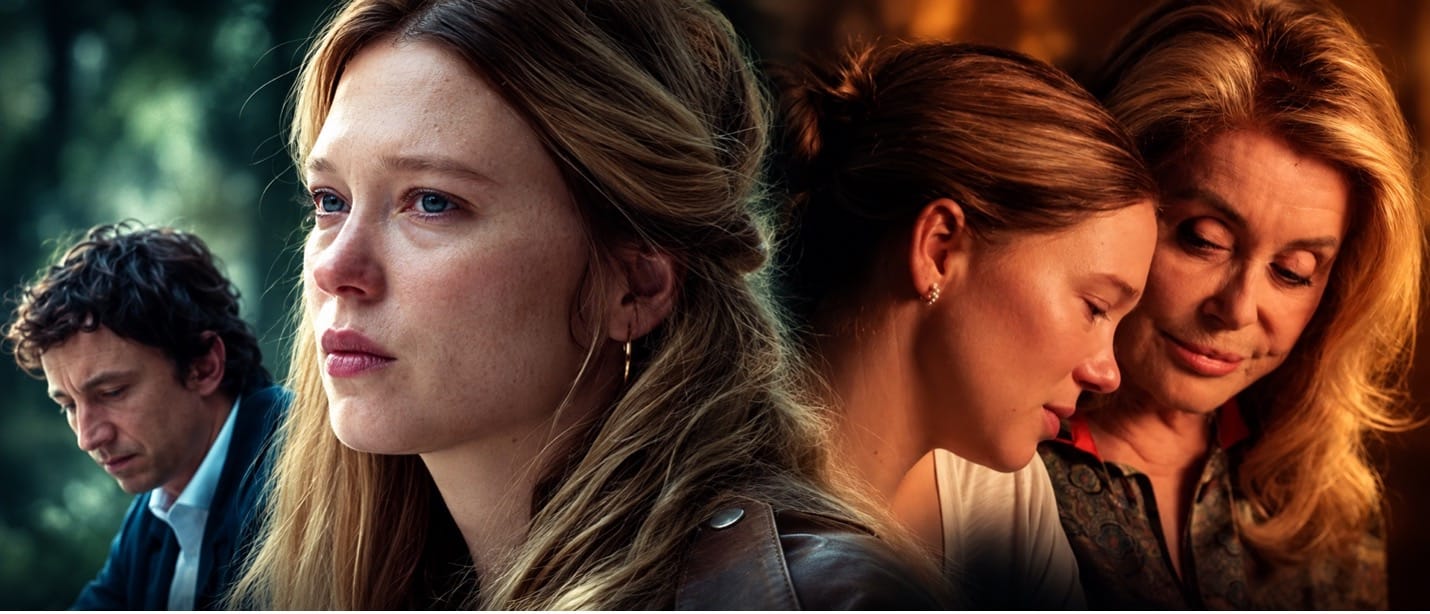
In a too small a role as Lucy’s concert pianist mother, Eloise, the legendary Catherine Deneuve has one trenchant scene in which she pushes Lucy on her continuing attachment to Philip, asking if she still loves him and if so, how. Does discovering something appalling about a partner automatically eradicate love? Lucy is not so sure. Is Philip actually a decent man who’s made a crushing mistake?
The trouble with “Gentle Monster” is that these relevant concerns are never fully or even sufficiently developed. And yet the film deserves credit for asking these questions at all. Kreutzer is quite skilled at showing how accusations made in the present can taint a view of the past that people have organized their entire lives around.
More crucially, these concerns are all visible in the indelibly internalized performance of Seydoux, who can move from hope to dread and all stops in between without uttering a single word. The actress also shows the subtle shift in Lucy from loyalty to her husband to her son, a change that will dominate her life in the present and beyond. Kreutzer sees this as a redefining moment for Lucy. And I don’t see how audiences won’t feel that same. With all its flaws, “Gentle Monster” will hit you hard.