
★★★½ (3½ out of 4)
"If too many people like a film I make, I feel like I've done something wrong."
--Jim Jarmusch
Not much chance of too many likes for “Father Mother Sister Brother,” the reliably idiosyncratic latest from Jim Jarmusch, the counterculture prince of cinema who’s now 72 but still with those shades and that shock of white hair that make him instantly recognizable and indisputably cool.
The new Jarmusch effort, proudly minus proper punctuation, is guaranteed to try the patience of his detractors and delight his advocates among whom I proudly stand, just so you know. Jarmusch makes movies where nothing and everything happens, depending on how you approach his technique to pack the most meaning into the space between words.
That is certainly the case with “Father Mother Sister Brother,” which was shockingly rejected by the Cannes Film Festival (bet that made him happy) yet won the Golden Lion, the top prize at the Venice competition. “Oh shit,” said Jarmusch on accepting the award, that thing again about too many people liking his work, though he did allow that art “fosters empathy.”
In this compassionate comedy of missed connection, Jarmusch makes us see the ordinary in fresh, pertinent and provocative ways. And the cumulative power of his vision is undeniable.
That’s certainly the case with “Father Mother Sister Brother,” a quietly humorous triptych, set in three different locations—New Jersey, Dublin and Paris—with three different families, exploring the complex and strained relationships between adult children and their parents. Slow-motion shots of skateboarders link the three sections, along with hot drinks, table settings and cars that symbolize the distance that exists among family members.
Jarmusch has done anthology films before, notably in “Mystery Train,” Night on Earth” and “Coffee and Cigarettes.” But the maturity and tenderness in “Father Mother Sister Brother” feels new and addictively captivating.
In the first episode, Jeff (a terrific Adam Driver) and his sister Emmy (a sharp-eyed Mayim Bialik) drive to the lakefront Jersey home of the father (a wonderfully growly Tom Waits) they haven’t seen in two years. There was an incident at their mother’s funeral, for which Jeff seems more forgiving. The visit is basically a wellness check at which Emmy notices dad’s Rolex (He claims it’s a fake.) and finds clues that dad is trying to make his life look worse than it is. Jarmusch establishes an almost formal politeness among the threesome, drawing laughs from discomfort.
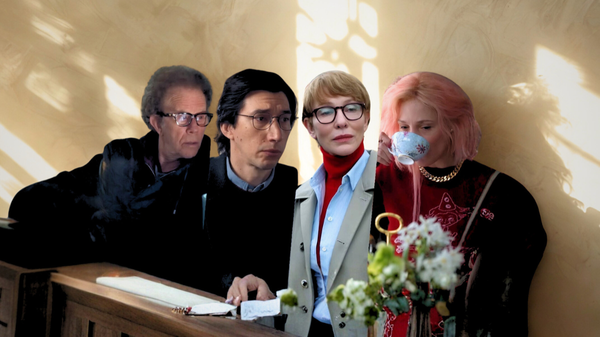
The middle section takes us to the Victorian home of a mother (the great Charlotte Rampling), a successful novelist whose two daughters—the prim, all-business Timothea (Cate Blanchett, remarkable) and wildcat, pink-haired Lilith (Vicky Krieps)—have moved to Dublin to be near but rarely close to their mother. Tim is successful, Lilith only pretends to be. The table, set with lavish cakes and a porcelain tea service, indicates a fragile bond. And here’s Jarmusch with a final glimpse of the daughters clasping hands in solidarity against the mystery of the matriarch.
In the final episode, sister Skye (Indya Moore) and twin brother Billy (Luka Sabbat) unite at the empty Paris apartment of their parents, who have died together in a private plane piloted by their mother. As they peruse photos and other totems of their youth, we realize how little they knew of these people who gave them life. Moore and Sabbat are heartbreakingly good as they try to figure out where their pieces fit in this generational puzzle.

For Jarmusch, these orphans in a parental storm cut deep into the elusive nature of the ties that bind. The parents and children Jarmusch presents are far from close-knit and still a long way from home in figuring out they fit together.
Maybe there’s an answer in “Spooky,” the twice referenced Dusty Springfield song: “If you decide some day to stop this little game that you are playing/I'm gonna tell you all the things my heart's been a-dyin' to be sayin'/Just like a ghost you've been a-hauntin' my dreams/But now I know you're not what you seem/Love is kinda crazy with a spooky little boy like you.”
Is Jarmusch that “spooky little boy,” evoking ghosts that tease at their secret hearts? Damn straight. Like the cinema poet he is, Jarmusch uses ephemera to hint at profundities. In the compassionate comedy of missed connection that is “Father Mother Sister Brother,” he makes us see the ordinary in fresh, pertinent and provocative ways. And the cumulative power of his vision is undeniable.