
★ (1 out of 4)
It gives me no pleasure to report that “Ella McCay,” the first film writer-director James L. Brooks has created in 15 years, stands on the bottom rung of his illustrious, pleasure-giving career. How could the Oscar winning dynamo behind “Broadcast News,” “Terms of Endearment,” “As Good as It Gets” and—OMG—“The Simpsons” have cobbled together such a tragic comedic mess?
Ageist critics will say Brooks is old (he’s 85) and out of touch and still smarting from the failure of his last film, 2010’s buried-in-bland “How Do You Know.” I say, how do you know that this legend won’t come back and show them all? We can only hope. But right now, the high-profile “Ella McCay “is dying out there right in the middle of Oscar and holiday season. And the critical autopsies are running graphic and cruel.
That’s the business. And Brooks deserves the respect of an honest review instead of getting a pass for old time’s sake. So I will iterate what I think are the holes that sink the ship of “Ella McCay” without being too smartass about it.
A low point in the career of James L. Brooks, starring gifted actors who seem, all of a sudden in a fit of group amnesia, to have forgotten how to act
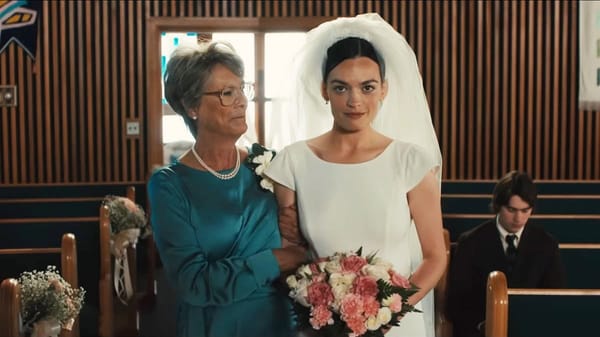
For starters, I can’t come down too hard on Emma Mackey, the British and French actress who was quite good with Gillian Anderson in “Sex Education.” It’s just that Mackey gets the worst of it since she plays the title role and has the most screen time. I never believed her for a second because Brooks has written and directed her as the flattest of character cardboard.
What we do know is that Ella is the 34-year-old lieutenant governor of an unnamed state (It was shot a lot in Providence, so OK, let’s call it Rhode Island.) and an unnamed political party (She spouts a lot of liberal pieties like “humans helping humans,” so let’s say Democrat.). Ella gets to be governor when her boss, Gov. Bill Moore (the great Albert Brooks in the only dull performance I’ve ever seen him give), steps down for a post in the Obama administration (Let’s call it 2008 because it fits and, hell, why not?).
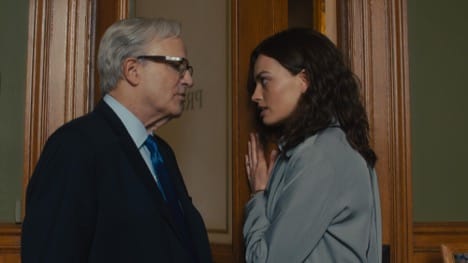
That leaves Ella to cope with a clown car of supporting characters played by gifted actors who seem, all of a sudden in a fit of group amnesia, to have forgotten how to act. The always wonderful Jamie Lee Curtis is shrill and obvious as Ella’s loyal Aunt Helen (They do scream therapy together that will have your nerves screaming.). The always appealing Woody Harrelson sinks without a trace into the massively clichéd role of Ella’s widowed father who philandered, shock of shockers, even before the death of Ella’s mother (an in-for-a minute and then mercifully out Rebecca Hall).
Then there’s Jack Lowden, so masterful on “Slow Horses” but ambushed here by the writing of the role of Ryan, Ella’s restauranteur husband, who starts acting like a little bitch when Ella won’t give him a role in her administration. Ryan sabotages his wife’s reputation by spreading trash talk about a sex scandal. Some scandal. He and Ella once had marital relations on government property, her office, which wouldn’t have raised an eyebrow in the Eisenhower era.
Also going down in this ship of banalities are Kumail Nanjiani as a chatty state trooper, Spike Fearn as Ella’s younger brother Casey (Spike Fearn), an agoraphobic who can’t manage his breakup with Ayo Edebiri’s Susan, and the legendary Julie Kavner—the iconic voice of Marge Simpson—stuck in the lifeless role of the narrator and Ella’s secretary Estelle, meant to fill in the blanks of a script that is virtually all blanks.
You can’t really blame the actors who are clearly working out of a deep respect and love for Brooks. I think we all feel that. That’s why our disappointment in “Ella McCay” runs so deep. Without the Brooks name in the credits, we might dismiss “Ella McCay” as a harmless relic from a time gone by that we don’t miss any more. But the Brooks name is there raising expectations of a gold standard in trenchant social comedy that we miss very much. What to do about it? Denial helps or just seeing “Ella McCay” as a rare stumble rectified by streaming one of his classics and remembering how long we thought of James L. Brooks only in terms of endearment. I’m going with that one.