
★★★½ (3½ out of 4)
Think back on those great true crime classics that Sidney Lumet directed in the 1970s, especially “Dog Day Afternoon” and “Serpico” with Al Pacino, and shout “hell yeah” that Gus Van Sant has crafted every frame of “Dead Man’s Wire” in that grand propulsive tradition. It’s a time bomb of a movie, a throwback geared to set your multiplex ablaze.
That it does. “Dead Man’s Wire” also gives Bill Skarsgård, best known as Pennywise the psycho clown in the “It” fright fests, a chance to make his unmasked mark as an actor. And does he ever, like Pacino did in those Lumet films. Maybe as a Van Sant good luck charm, Pacino also appears in “Dead Man ‘s Wire,” this time as an entitled Indiana fat cat from Indianapolis sure to spark your anti-Establishment bias.
Skarsgård’s Tony Kiritsis is, to quote another 1970s landmark, “mad as hell and not gonna take it anymore.” Pacino plays M.L. Hall, the target of Tony’s rage and the founder of the Meridian Mortgage Company, which calls in Tony’s loan—he’s behind on payments—to finance 17 acres of real estate on which he plans to build a shopping mall. It’s a Shark Tank wet dream and Tony loses it when Hall shatters his fantasy.
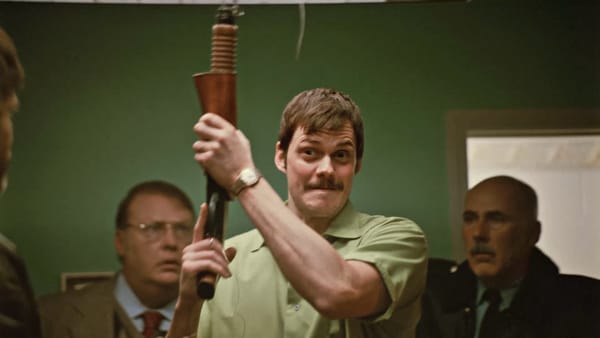
Bill Skarsgård, best known as Pennywise the psycho clown in the 'It' fright fests, gets a chance to make his unmasked mark as an actor. And does he ever.
So on a freezing winter morning at 8 am on February 8, 1977, the 44-year-old Tony walked into the Meridian offices intending to demand retribution from its owner, who unbeknownst to Tony was soaking up the Florida sunshine. Quickly improvising, Tony kidnaps the old man’s son, Richard Hall (the daringly implosive Dacre Montgomery of “Stranger Things”) and attaches the so-called dead man’s wire to him.
It’s a device Tony wraps around Richard’s neck, one end attached to a sawed-off shotgun pressed to the back of Hall’s head, the other connected to Tony’s finger on the trigger. Any sudden movement, from Richard or police, and kaboom.
Van Sant, whose work eases from indie (“Drugstore Cowboy,” “To Die For”) to the Oscar mainstream (“Good Willing Hunting,” “Milk”), creates you-are-there atmospherics to draw us into the action as Tony moves Richard to his booby-trapped apartment and begins a 63-hour standoff covered obsessively on live TV.
In lesser hands, the wire noose would be just a gimmick. With Van Sant and screenwriter Austin Kolodney, it’s a way to spring actors from studied plot mechanics and allow them to create flesh-and-blood characters out of a now forgotten news story. The film rises bracingly to the challenge, freeing the performers to do indelible, idiosyncratic work.
As a man on a tightrope, Skarsgård finds the offhand humor in Tony, as he swaps stories with daddy-whipped Richard. Montgomery’s reactions are priceless when M.L. refuses by phone to admit that he cheated, even to save his son’s life. Pacino barks the role gloriously. It’s hilarious watching Tony trying to enlist Richard in his plot against dad’s dirty business.
Van Sant also handles Tony’s neurotic need for media attention with satirical panache. Tony uses the TV coverage as a forum to demand a public apology from Meridian, immunity from prosecution, a release from his $130,000 mortgage loan and—get this—an extra $5 million in, er, damages. The barbs continue when the matchlessly cool Colman Domingo shows up as popular radio DJ and phone-in host Fred Temple, “the voice of Indianapolis,” used and abused by Tony to voice his own grievances.
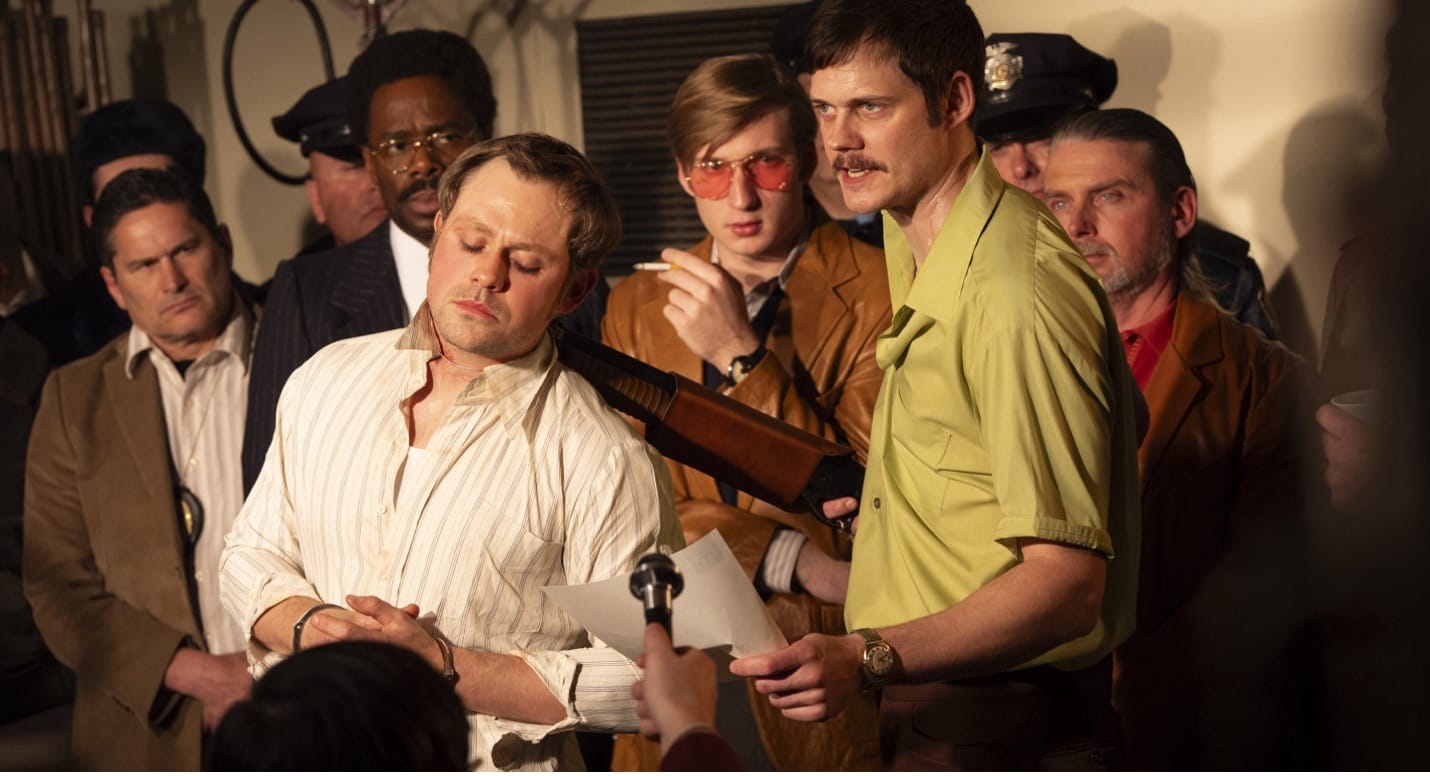
Van Sant keeps his tale brisling with real-life figures — Cary Elwes as Tony’s detective pal Mike Grable, Daniel R. Hill as Tony’s grasping brother Jimmy Kiritsis, and Myha’la of “Industry” as rookie reporter Linda Page—all exploiting Tony for their own agendas.
Everyone is complicit. Skarsgård, much like Pacino in “Dog Day Afternoon,” refuses to let Tony off the hook as a folk-hero David fighting the Goliath of American capitalism. There’s a dangerous glint of paranoia in his eye, a volatility that keeps “Dead Man’s Wire” thrillingly alive instead of another embalmed recitation of true crime facts.
Van Sant throws Skarsgård and Montgomery into an intriguing imbalance, both raging inside but only one willing to break the bonds of sanity. You can feel Van Sant rooting for the underdog striver in Tony, but he won’t make it easy for him.
You can just ask AI if you want to know what happened to Tony. How much better to let Van Sant lead you down a few dark psychological corners not investigated by the media. “Dead Man’s Wire” doesn’t have all the answers, but the provocative questions it asks about guilt and innocence may just keep you up nights. You won’t know what hit you.